Beyond Basics: Advanced RAG Patterns and Pipelines for Production-Ready AI
Introduction: Why Go Beyond Basic RAG?
Retrieval-Augmented Generation (RAG) has quickly become the go-to approach for building AI applications that combine large language models (LLMs) with external knowledge. It powers chatbots, search, analytics, and assistants that stay grounded in facts.
But as soon as you move from a simple demo to a production system, new challenges emerge:
- How do you scale retrieval without slowing down responses?
- How do you reduce hallucinations when your documents are noisy or incomplete?
- How do you trade off accuracy against latency?
This post explores advanced RAG patterns and pipelines that we learned in class — practical strategies to take your RAG system from a prototype to a production-grade knowledge engine.
1. Scaling RAG Systems
A simple RAG pipeline has two steps: retrieve documents and generate answers. In practice, scaling means:
- Using sharded vector stores to handle millions of documents.
- Adding query caches to avoid repeatedly running expensive retrievals.
- Using asynchronous parallel retrievals across multiple indexes (structured + unstructured).
Think of it as building lanes on a highway: the wider the lanes, the more queries can flow without traffic jams.
2. Accuracy vs Speed: Finding Balance
Every production system faces a latency vs quality trade-off.
- Higher recall (fetching more documents) improves accuracy but slows things down.
- Smaller retrieval sets make responses faster but risk missing context.
A common trick is progressive retrieval: start with fewer docs for speed, and only expand if confidence is low.
3. Query Translation & Sub-Query Rewriting
Users don’t always ask questions the way your system expects. That’s where query rewriting comes in.
- Query Translation: Convert natural questions into structured query forms for databases or APIs.
- Sub-Query Decomposition: Break complex questions into smaller queries and stitch results back together.
🔎 Example:
“Compare Tesla’s revenue growth with GM’s R&D spending in the last 3 years.”
Instead of one big retrieval, the system reformulates into two sub-queries and aggregates.
4. Using LLM as an Evaluator
Instead of blindly trusting retrieval, you can let the LLM act as a critic:
- Rank retrieved passages by relevance.
- Filter out off-topic results.
- Score answers before sending them to the user.
Think of it like having a second set of eyes proofreading before the final draft.
5. Ranking Strategies and HyDE
Retrieval quality is as much about ranking as it is about retrieval.
- Traditional Ranking: based on cosine similarity in vector space.
- Hybrid Strategies: combine keyword search + dense embeddings.
- HyDE (Hypothetical Document Embeddings): Ask the LLM to “imagine” a likely answer, embed it, and use that as the query for retrieval. This often pulls in better-contextual documents.
6. Corrective RAG
What if the initial retrieval fails? Corrective RAG introduces a feedback loop where the LLM can say:
- “I don’t have enough info; let me reformulate the query.”
- Re-run retrieval with refined queries.
This is like asking follow-up questions during a conversation until you have enough context to give a solid answer.
7. Caching for Speed
Retrieval and generation are expensive. Smart caching saves cost and latency:
- Query-level caching: Store embeddings for common queries.
- Document-level caching: Frequently retrieved docs don’t need recomputation.
- Response caching: Save final answers when queries repeat.
8. Contextual Embeddings & Hybrid Search
Not all embeddings are equal. Improving embedding generation can boost retrieval dramatically:
- Contextual Embeddings: Use richer prompt-based embeddings that capture query intent.
- Hybrid Search: Blend vector search with keyword/semantic filters. For example, combine BM25 for exact matches with embeddings for fuzzy matching.
9. GraphRAG: Knowledge as a Network
Instead of treating documents as flat text, GraphRAG builds a graph where entities (people, orgs, events) are nodes and relationships are edges. Retrieval then becomes reasoning over connections, not just keyword matches.
Imagine asking: “Who partnered with Tesla in battery technology last year?” — GraphRAG fetches not only Tesla documents but also links partnerships across multiple sources.
10. Production-Ready Pipelines
Putting it all together for real-world deployment:
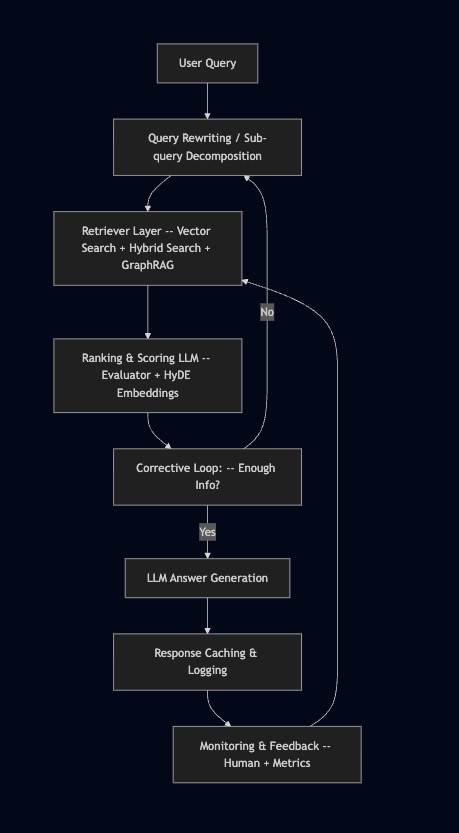
- Multi-stage Pipelines: Query rewriting → retrieval → ranking → LLM scoring → generation.
- Monitoring & Logging: Track retrieval hit rates, response latency, and hallucination levels.
- Human-in-the-loop Feedback: Gather user ratings to continuously refine retrieval strategies.
- Continuous Index Updates: Keep knowledge bases fresh through automated ingestion.
An advanced RAG pipeline combines retrieval, ranking, corrective loops, evaluation, and caching into a feedback-driven architecture for reliable outputs
Conclusion: From RAG to Reliable AI
Basic RAG is just the starting point. With advanced patterns like HyDE, corrective feedback, caching, hybrid search, and GraphRAG, we can build scalable, accurate, and production-ready pipelines that transform retrieval from a simple lookup into intelligent knowledge orchestration.
The future of RAG isn’t just about finding documents — it’s about designing self-improving systems that reason, adapt, and keep users’ trust.
👉 Pro Tip: Start small with one or two techniques (like caching + ranking) and expand gradually. Trying to implement everything at once can add unnecessary complexity.
Comments
Join the discussionNo comments yet. Be the first to comment.
GenAI
In this series, you’ll learn Generative AI from basics to advanced — step by step, with hands-on coding, experiments, and real-world use cases.


